
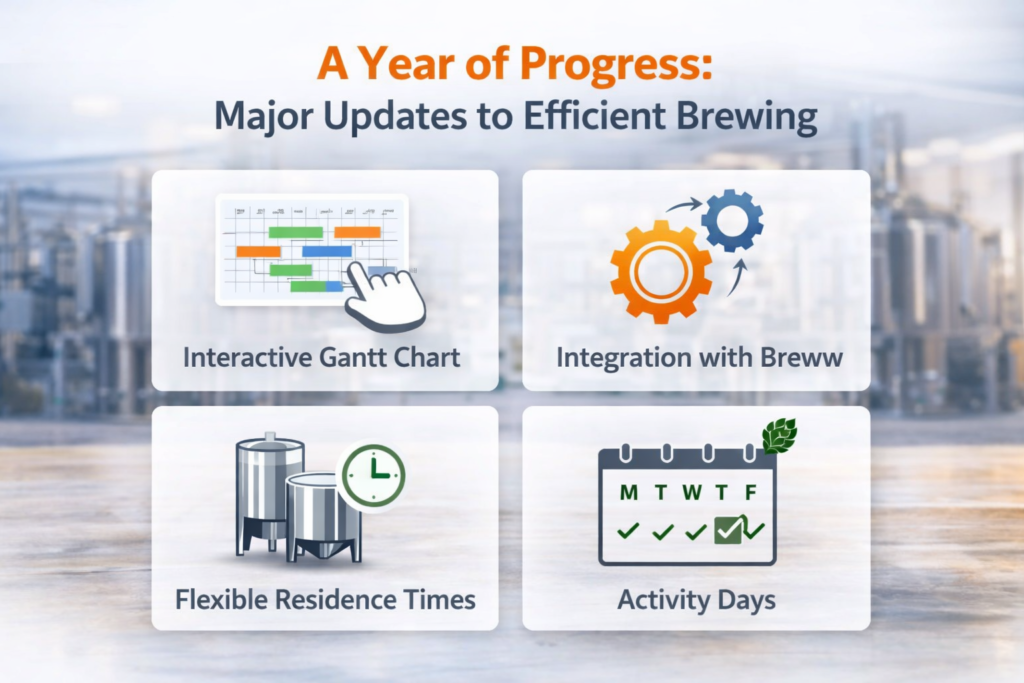
Over the last year, Efficient Brewing has evolved significantly.
When building software for breweries, the goal is not simply to add features. The aim is to make production planning more practical, more flexible, and more aligned with how breweries actually operate day to day.
This past year has brought four major improvements to the Efficient Brewing scheduling system. Each one has focused on giving brewers more control, more realism, and less friction when planning production.
1. A more interactive Gantt chart
The Gantt chart has always been central to Efficient Brewing. It provides a clear visualisation of the optimised production schedule — showing what to brew, when to brew it, and where it will take place.
Previously, the chart was primarily for display.
Now, it is interactive.
Brewers can:
- Adjust task durations
- Move tasks in time
- Reassign tasks to different equipment
This change transforms the chart from a static output into a practical scheduling tool.
Optimisation still provides a strong baseline schedule. But real breweries face real changes — delays, equipment constraints, priority shifts. The interactive Gantt chart allows you to refine the schedule quickly without starting again from scratch.
It bridges the gap between mathematical optimisation and operational reality.
2. Integration with Breww
Another major step forward this year has been the integration with Breww.
One of the biggest barriers to adopting decision-support tools is setup time. No brewer wants to manually recreate tanks, batches, and equipment lists in a second system.
With the new integration:
- Generate an API key in Breww
- Add it to Efficient Brewing
- Click “Sync”
Your batches and equipment data are imported directly.
This significantly reduces the time required to get started. In many cases, a brewery can move from sign-up to running optimisation in under 30 minutes.
While recipe data still needs to be added manually, the removal of duplicated data entry is a meaningful improvement for Breww users.
3. More flexible beer type specifications
Breweries rarely follow a perfectly simple two-stage process of fermentation and conditioning.
Previously, Efficient Brewing assigned a fermentation time and optionally a conditioning time to each beer type. While this worked in many cases, it was too rigid for breweries with more complex processes.
This year, that structure was replaced with flexible vessel residence times.
Now, for each beer type, you simply define:
- The equipment type (for example, fermentation vessel or conditioning vessel)
- The time the beer remains in that vessel
You can add as many stages as necessary.
If a beer moves through fermentation, conditioning, maturation, and additional storage — you can model that. If it only requires one stage — that is equally valid.
This update makes the system far more adaptable to different brewery setups and production philosophies.
4. The addition of activity days
Scheduling is not only about where beer sits. It is also about when work needs to be done.
Certain beers require specific interventions during production — dry hopping, transfers, additions, sampling. These activities often need to happen on a particular day of the process.
For practical reasons, it is ideal if those activity days fall on a normal working day. No brewer wants to come in on a Sunday just to add dry hops if it can be avoided.
Efficient Brewing now allows you to define activity days for each beer type.
When optimisation generates a schedule, it respects those activity days. The system will align production timing so that required activities fall on appropriate working days.
This is a small detail, but one with real operational impact.
A more practical optimisation tool
Taken individually, each of these improvements adds flexibility.
Together, they represent something more significant.
Efficient Brewing has moved beyond being purely an optimisation engine. It is becoming a more practical, brewery-aware scheduling system — one that reflects the realities of equipment constraints, process variability, and human working patterns.
- Interactive schedules
- Seamless data integration
- Flexible production modelling
- Real-world activity constraints
The goal remains the same: to help breweries make better production decisions using their own data.
But better decisions require tools that reflect how breweries actually operate.
This year has been about making Efficient Brewing more aligned with that reality.
We all make decisions in our own way. The right tools simply make those decisions easier.