
When Shakespeare asked, “What’s in a name?”, he was questioning whether a label truly captures the essence of something. It is a fair question to ask of charts too. What’s in a chart?
In brewing, quite a lot.
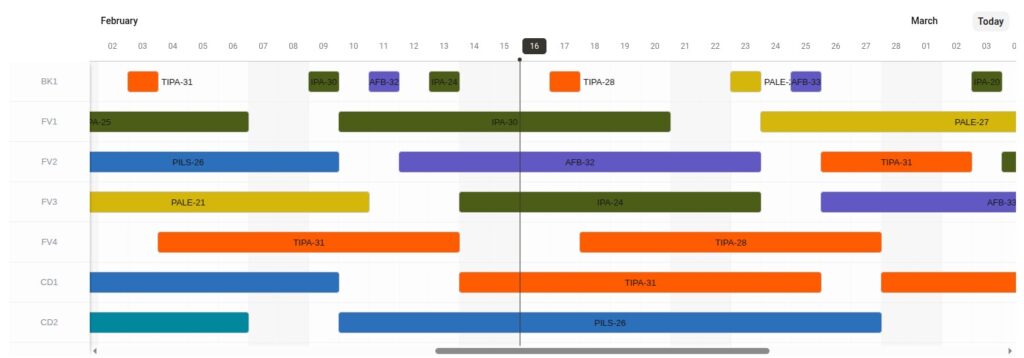
For some time, the Gantt chart inside the Efficient Brewing scheduling system has played an important role. It has shown you the outcome of optimisation — a clear production schedule laid out across tanks, brewhouse and packaging. It allowed you to see when batches start, how long they run, and how equipment is utilised.
But until now, it was mainly for display.
The latest update changes that completely.
The old Gantt chart – clear but static
The original Gantt chart did exactly what it was designed to do. After running optimisation, it presented a production schedule in a clean and understandable way. You could quickly assess:
- When each brew would start
- How long fermentation would take
- When tanks would be free
- Where bottlenecks might occur
For many breweries, this visibility alone brought significant value. Seeing the schedule laid out visually often highlights things that spreadsheets never do.
However, once the schedule was created, interaction was limited. If something needed to change — a delay, a tank issue, a revised duration — you would typically need to re-run optimisation or adjust data outside the chart itself.
The chart showed the plan. It did not help you reshape it.
The new Gantt chart – interactive and flexible
The updated Gantt chart introduces a much more hands-on scheduling experience. It transforms the chart from a static display into an interactive planning tool.
There are three key improvements.
1. Change task durations
Brewing rarely follows exact theoretical timings. Fermentation might finish earlier. Cleaning might take longer. Packaging might be delayed.
You can now directly adjust the duration of tasks within the Gantt chart itself.
This allows you to reflect reality quickly. Instead of rebuilding the schedule from scratch, you simply adjust what has changed.
2. Move tasks in time
Plans shift. Raw materials arrive late. A customer order becomes urgent. A brewer needs to reshuffle the week.
You can now drag and move tasks along the timeline.
This makes it far easier to respond to day-to-day operational changes while still maintaining structure in your production plan.
3. Move tasks between equipment
Perhaps the most powerful addition is the ability to move tasks between different pieces of equipment.
If a fermenter becomes unavailable, or if you decide to use a different tank for operational reasons, you can now reassign the task directly within the chart.
This gives you practical control over the schedule without losing the optimisation logic that created it.
From optimisation to practical scheduling
Optimisation remains at the heart of the Efficient Brewing scheduling system. It still calculates a high-quality production plan based on your data, constraints and demand.
However, real breweries operate in real time.
No mathematical model can perfectly anticipate every operational detail. What matters is how easily you can adapt once the schedule meets reality.
The new Gantt chart bridges that gap.
You can run optimisation to generate a strong baseline schedule. Then, using the interactive chart, you can refine and adjust that schedule to suit practical circumstances — quickly and intuitively.
This makes the system not just an optimisation engine, but a true scheduling tool.
What’s in a chart?
A chart can be just a picture. Or it can be a working part of your production system.
With this update, the Gantt chart inside Efficient Brewing becomes more than a visualisation. It becomes an interactive layer between optimisation and day-to-day operations.
- Better visibility.
- Better control.
- More flexibility.
If you are already using Efficient Brewing, I encourage you to explore the new scheduling interface and see how it fits into your planning process.
If you are not yet using Efficient Brewing, and production planning is becoming more complex, perhaps it is time to consider whether a more flexible scheduling system could support your next stage of growth.
We all make decisions in our own way. The right tools simply make those decisions easier.